Personal Loan vs. Credit Card: Which Is Cheaper for a Big Expense?
Borrowing $8,000? We compare a personal loan and a credit card side by side — monthly payment, total interest and fees — so you can pick the cheaper option.
Need to cover a large expense — a car repair, a medical bill, a move or a home project? Two of the most common ways to borrow are a personal loan and a credit card. They can cost wildly different amounts, so it pays to compare before you swipe or sign.
Quick answer
A personal loan is usually cheaper for large amounts you’ll repay over a year or more, because rates are typically lower than credit cards and the fixed payment forces you to finish on schedule.
A credit card can be cheaper for small amounts you’ll repay within a month or two, or if you qualify for a 0% intro APR offer and can pay it off before the promo ends.
Personal loan vs. credit card at a glance
Personal loan
Credit card
How you get the money
One lump sum
Spend as needed, up to your limit
Interest rate
Fixed, often lower (depends on credit)
Variable, usually higher
Payment
Same amount every month
Minimum changes with your balance
Payoff date
Fixed (e.g., 36 months)
None — you can carry a balance indefinitely
Fees
Possible origination fee (often 0%–10%)
Possible annual fee, late fees, cash advance fees
Best for
Big, one-time costs; consolidating debt
Small or short-term purchases; 0% promos
Example: borrowing $8,000 over 3 years
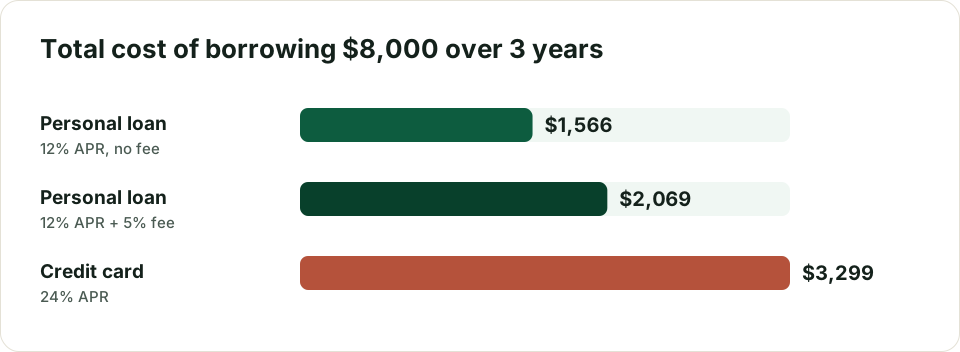
Let’s compare what it really costs to borrow $8,000 and pay it off in 36 months. (Rates are examples only — your offer depends on your credit, income and lender.)
Option 1: Personal loan at 12% APR, no fee
Monthly payment: $265.71
Total interest: $1,565.72
Option 2: Personal loan at 12% APR with a 5% origination fee
Many lenders take the fee out of the loan before you receive it. To end up with $8,000 in hand, you’d need to borrow about $8,421.
Monthly payment: $279.70
Total cost above the $8,000 you needed: $2,069.18
Option 3: Credit card at 24% APR, paid off in 36 months
Monthly payment needed: $313.86
Total interest: $3,299.06
What the numbers show
Even with a 5% fee, the personal loan in this example costs about $1,230 less than the credit card. Without a fee, it saves more than $1,700.
And there’s a hidden risk with the card: nothing forces you to pay $313.86 a month. If you pay only the minimum, the balance can drag on for years and the interest can climb far higher.
When a credit card is the better choice
A credit card can win when:
You can repay in full before the statement due date. No interest is charged on purchases if you pay the full statement balance on time.
You qualify for a 0% intro APR card. Some cards offer 0% on purchases or balance transfers for a limited period. If you divide the balance by the number of promo months and pay at least that much every month, you could borrow for free (minus any transfer fee).
The amount is small. Many personal loans have minimum amounts, and applying for a loan to cover $400 rarely makes sense.
You want rewards or purchase protection. Some cards offer cash back, extended warranties or fraud protections.
When a personal loan is the better choice
A personal loan usually wins when:
The amount is large and will take more than a few months to repay.
You want a fixed payment and a clear end date.
You’re consolidating high-interest credit card debt. Rolling several card balances into one lower-rate loan can save interest and simplify your bills. (Just don’t run the cards back up.)
Your credit is good enough to get a competitive rate. The better your credit score, the bigger the gap between loan and card rates tends to be.
How to compare offers the right way
Compare APR, not just the interest rate. APR includes certain fees, so it’s a better apples-to-apples number.
Check for an origination fee and whether it’s deducted from the amount you receive.
Use prequalification. Many lenders show you an estimated rate with a soft credit check, which doesn’t affect your credit score. A hard inquiry only happens when you formally apply.
Look at the total cost, not only the monthly payment. A longer loan term lowers the payment but usually raises the total interest.
Watch for prepayment penalties. Most personal loans let you pay early for free, but confirm it.
Check the lender is legitimate. In the U.S., be wary of anyone who asks for an upfront fee before giving you a loan — that’s a common scam. Canadian and UK borrowers should check that the lender is licensed or authorized (for example, on the FCA register in the UK).
Alternatives worth considering
Credit union loans: credit unions often offer lower rates, especially to members with modest credit.
0% balance transfer card: good for paying down existing card debt if you can finish within the promo period.
Payment plan with the provider: hospitals, repair shops and schools may offer interest-free installment plans — always ask.
Emergency fund: the cheapest loan is the one you don’t need. Even a small fund can keep minor surprises off your credit card.
FAQ
Does a personal loan hurt your credit score?
Applying causes a hard inquiry, which may lower your score slightly for a short time. Over time, on-time payments can help your score, and consolidating card balances into a loan can reduce your credit utilization.
Is it bad to carry a balance on a credit card?
Carrying a balance doesn’t help your score and costs you interest. Paying your statement balance in full every month is the cheapest way to use a credit card.
What credit score do I need for a personal loan?
It varies by lender. Some work with fair credit, but the lowest rates usually go to borrowers with good to excellent credit and stable income.
This article is for educational purposes only and is not personalized financial advice. Example rates are illustrative; actual rates and fees vary by lender and borrower. Read our Disclaimer.