Online Job Scams: 10 Red Flags and How to Tell If a Job Is Real
How to tell if an online job is a scam: 10 red flags, the most common work-from-home scams (task scams, fake checks, reshipping) and what to do if you already paid.
How to really compare international money transfers: fees, exchange rates and what your family receives. A $500 example, your rights and how to avoid scams.

Quick answer: the cost of sending money has two parts: the transfer fee and the exchange rate markup. A “no fee” service can still be the expensive one, so compare how much your family receives, not the fee.
If you send money to family in another country, every dollar counts. What many people don’t realize is that the cost of a transfer isn’t just the fee: the exchange rate you get can cost you more than the fee itself. Here’s how to compare properly.
If the real rate is 100 and the company gives you 97, you’re paying a hidden 3%.
Imagine three different services (an illustrative example, no real brands):
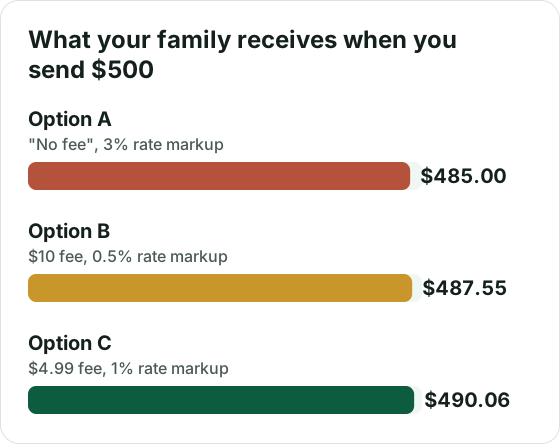
The “no fee” option was the most expensive. That’s why the only number that matters is: exactly how much does your family receive?
U.S. tax on cash-funded remittances: for transfers made on or after January 1, 2026, there’s a 1% federal tax on remittances paid in cash, by money order, by cashier’s check or with a similar physical instrument. The sender pays it and the provider collects it. It generally doesn’t apply if you pay from a bank account or with a U.S.-issued debit or credit card. If you usually pay cash at a store, paying by card or from an account avoids the tax. Check with your provider how it affects you.
CFPB rules protect people sending remittances from the U.S. through companies that do this regularly. In general:
If a company doesn’t resolve your problem, you can file a complaint at consumerfinance.gov.
Is it better to send money through a bank or a transfer company? It depends on the country and the amount. Banks sometimes charge high fees for international wires; specialized services are often cheaper — but always compare the final amount received.
Is there a limit on how much I can send? Providers set their own limits and may ask for ID for large transfers. The destination country may also have its own rules.
Do I have to report money I send? For normal transfers to family, usually not. But if you send one person more than the IRS annual gift tax exclusion in a year, you as the sender may have to file Form 709 (usually without owing any tax). The destination country may have its own rules too. If you send large sums, talk to a professional.
This article is for educational purposes only and is not financial advice. The example is illustrative; fees and exchange rates change constantly. Read our Disclaimer.
Links open the official websites. Rules change: always check the latest information there.
How to tell if an online job is a scam: 10 red flags, the most common work-from-home scams (task scams, fake checks, reshipping) and what to do if you already paid.
What documents you need to open a U.S. bank account without an SSN (passport, ITIN, consular ID), where to open one and how to avoid fees.
The differences between a high-yield savings account, a certificate of deposit (CD), a money market account and a money market fund — and which fits each goal.