When Will I Get My Tax Refund? Timeline, Delays and How to Track It
How long a tax refund takes: about 3 weeks if you e-file, 6 weeks or more by mail, and early March if you claim the EITC or ACTC. How to track it and what delays it.
What a tax deduction is, what a tax credit is, why a $1,000 credit is worth far more than a $1,000 deduction, and the most common ones in the U.S.

Quick answer: a deduction lowers your taxable income, while a credit lowers your tax bill dollar for dollar. In the 12% bracket, a $1,000 deduction saves you $120, but a $1,000 credit saves you the full $1,000.
During tax season you’ll hear about deductions and tax credits as if they were the same thing. They aren’t — and understanding the difference can keep you from leaving money on the table.
Say you’re in the 12% federal tax bracket:
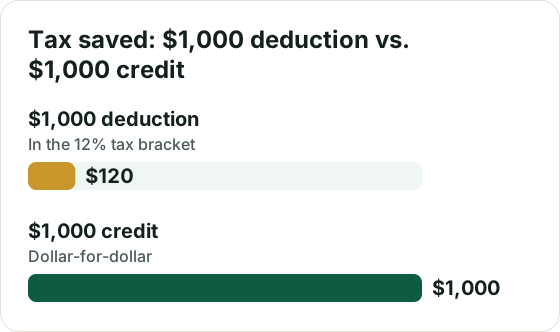
That’s why, for the same amount, a credit is almost always worth more.
Another common credit is the Child and Dependent Care Credit. The home energy efficiency and clean energy credits were eliminated for expenses or installations after December 31, 2025 by the 2025 tax law (the One Big Beautiful Bill). Requirements and amounts change, so always check IRS.gov.
Important for ITIN families: some credits require a Social Security Number. The EITC has required one for years, and starting with tax year 2025 the Child Tax Credit requires a valid SSN not only for the child but also for the taxpayer. If you file jointly and only one spouse has an SSN, confirm your situation on IRS.gov or with a certified preparer. Families who don’t qualify may be able to claim the smaller Credit for Other Dependents. If you file with an ITIN, check each credit’s rules before counting on a refund.
| Your federal tax bracket | $1,000 deduction saves | $1,000 credit saves |
|---|---|---|
| 10% | $100 | $1,000 |
| 12% | $120 | $1,000 |
| 22% | $220 | $1,000 |
| 24% | $240 | $1,000 |
Say you owe $400 in tax and qualify for a $1,000 credit:
| Type of credit | Tax you owe after the credit | Money back |
|---|---|---|
| Nonrefundable | $0 | $0 (the other $600 is lost) |
| Refundable | $0 | $600 |
| Partly refundable | $0 | Depends on the credit’s limit |
So when you see a credit, check whether it’s refundable. The amounts here are examples, and each credit has its own rules.
Can I take the standard deduction and claim credits? Yes. The standard deduction and credits are independent.
Does a deduction give me a refund? Indirectly: by lowering your tax, it can increase your refund if too much was withheld — but the deduction itself isn’t “paid” to you.
Should I itemize or take the standard deduction? Choose whichever is larger. Most people come out ahead with the standard deduction.
This article is for educational purposes only and is not tax advice. Credits, deductions and rules change every year; check IRS.gov or consult an authorized professional. Read our Disclaimer.
Links open the official websites. Rules change: always check the latest information there.
How long a tax refund takes: about 3 weeks if you e-file, 6 weeks or more by mail, and early March if you claim the EITC or ACTC. How to track it and what delays it.
W-2 vs. 1099 explained: who withholds your taxes, how much more a contractor pays in Social Security and Medicare, what you can deduct and what to do if you think you're misclassified.
Yes, money made online is taxable, even without a 1099. How 1099-K and 1099-NEC work, when you owe self-employment tax, what you can deduct and how to avoid penalties.