Online Job Scams: 10 Red Flags and How to Tell If a Job Is Real
How to tell if an online job is a scam: 10 red flags, the most common work-from-home scams (task scams, fake checks, reshipping) and what to do if you already paid.
How to split your paycheck with the 50/30/20 rule: what counts as needs, wants and savings, a $3,000 example and how to adapt it when money is tight.
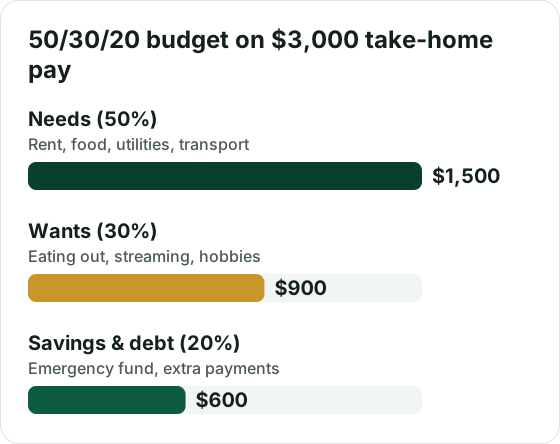
Quick answer: the 50/30/20 rule splits your take-home pay into 50% for needs, 30% for wants and 20% for savings and extra debt payments. On $3,000 a month, that’s $1,500, $900 and $600.
If you’ve ever reached the end of the month wondering where your money went, the 50/30/20 rule is one of the simplest ways to start a budget. You don’t need to track every coffee — just split your income into three groups.
🧮 Split your own paycheck in seconds with our free 50/30/20 budget calculator.
Take your take-home pay (what actually lands in your account after taxes and deductions) and divide it like this:
It’s very common, especially in cities with high rent. Don’t worry — the rule is a guide, not a law. You can adapt it:
A good order:
Keep savings in a high-yield savings account so they earn interest.
| Monthly take-home pay | Needs (50%) | Wants (30%) | Savings and debt (20%) |
|---|---|---|---|
| $2,000 | $1,000 | $600 | $400 |
| $3,000 | $1,500 | $900 | $600 |
| $4,000 | $2,000 | $1,200 | $800 |
| $5,000 | $2,500 | $1,500 | $1,000 |
Paid every two weeks? Multiply one paycheck by 26 and divide by 12. A $1,400 paycheck is about $3,033 a month.
Try your own numbers with our free 50/30/20 budget calculator.
Are minimum debt payments needs or savings? The minimum goes under needs; anything extra goes in the 20%.
Does it work if I’m paid weekly or biweekly? Yes. Apply the same percentages to each paycheck, or calculate your monthly average.
Are there alternatives to 50/30/20? Yes — like zero-based budgeting (every dollar gets a job) or the envelope method. The best one is the one you’ll actually use.
This article is for educational purposes only and is not personalized financial advice. Read our Disclaimer.
Links open the official websites. Rules change: always check the latest information there.
How to tell if an online job is a scam: 10 red flags, the most common work-from-home scams (task scams, fake checks, reshipping) and what to do if you already paid.
What documents you need to open a U.S. bank account without an SSN (passport, ITIN, consular ID), where to open one and how to avoid fees.
The differences between a high-yield savings account, a certificate of deposit (CD), a money market account and a money market fund — and which fits each goal.