Quick answer: a credit-builder loan is a loan in reverse: the lender holds the money while you make monthly payments for 6 to 24 months, reports them to the credit bureaus, and gives you the money at the end. It’s a low-risk way to build history, but it won’t help in an emergency.
A credit-builder loan is a loan in reverse: you pay first and get the money later. It sounds odd, but it’s designed for people with no history (or a poor one) who want to build credit without risking debt.
How it works
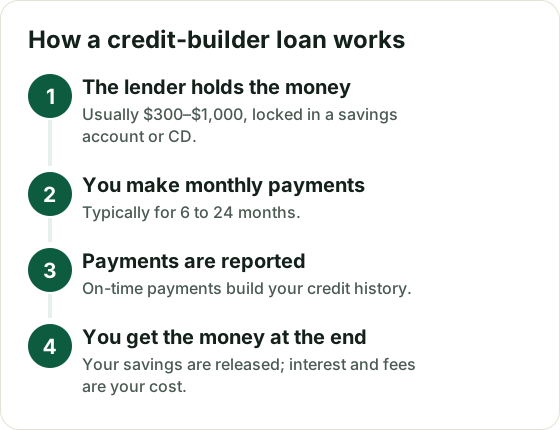
The lender approves a small loan, usually $300 to $1,000, but doesn’t give you the money — it holds it in a savings account or certificate of deposit (CD).
You make monthly payments for 6 to 24 months.
Each on-time payment is reported to the credit bureaus, building your history.
At the end, you get the saved money. Your cost is the interest and fees.
What it costs
It depends on the lender. Some charge an origination fee and interest; others charge little or nothing. Because the loan is small, the total cost is usually modest — but compare: ideally you pay little more than you would for forced savings.
A real example: what one costs
To make the cost concrete, here’s a real plan from Self, one of the best-known credit-builder providers, as shown on its official pricing page on October 28, 2026. We earn nothing if you sign up, and plans change, so check the current terms before you apply.
Self Credit Builder Account (example plan)
Monthly payment
$35
Term
24 months
Total you pay
$840
What you get back at the end
$717
Finance charge (your cost)
$123
APR
15.69%
Hard credit inquiry to apply
No
Reports to all three credit bureaus
Yes
In plain terms: you pay about $5 a month in interest and fees to build two years of on-time payment history, and you finish with about $717 saved. Other plans had different monthly amounts ($25, $48 and $150 at the time of checking), and a credit union may offer a similar loan for less, so compare before you choose.
Pros
Easy approval: since the lender doesn’t hand you the money, the risk is low.
Forced savings: you end up with a small fund — maybe the start of your emergency fund.
Adds a different credit type: an installment loan, which complements a card well.
No risk of overspending, unlike a card.
Cons
No cash when you need it. It’s not for emergencies.
A late payment hurts: the loan can damage your credit just as it can help it.
It doesn’t lower your credit utilization, because it isn’t a card (see credit utilization).
Can I pay it off early?
Many lenders allow it, but paying it off very quickly reduces the number of reported payments — which is exactly what builds your history.
What if I stop paying?
Late payments will be reported and you’ll lose part of the benefit. Some lenders close the loan and return your savings minus what you owe.
How soon will I see results?
Usually, after about 6 months of payments, a first score can be generated.
This article is for educational purposes only and is not financial advice. Terms vary by lender. Read our Disclaimer.
How to find a credit-builder loan near you: credit unions, community banks, CDFIs and online lenders, what each costs, what to ask and how to tell if one is worth it.