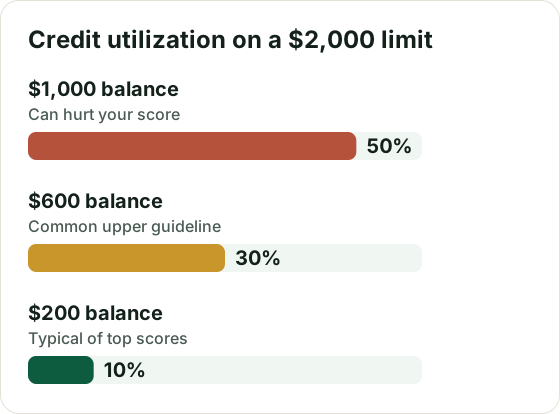
Quick answer: credit utilization is how much of your card limits you’re using: a $600 balance on a $2,000 limit is 30%. Staying under 30% is the common guideline, and under 10% is typical of the highest scores. It can improve within weeks.
After paying on time, the factor that affects your credit score most is how much of your available credit you’re using. It’s called credit utilization, and the good news is you can improve it within weeks.
Example: if your cards have a combined limit of $2,000 and your balance is $600, your utilization is 30%.
It’s measured two ways, and both count:
Overall: all your cards together.
Per card: each card on its own. One maxed-out card can hurt you even if your overall ratio is low.
What percentage should you aim for?
Under 30%: the most common guideline.
Under 10%: typical of people with the highest scores.
0%: not ideal. Having no reported usage at all can be slightly worse than low usage. One small purchase a month, paid in full, is enough.
According to FICO, “amounts owed” (where utilization weighs heavily) makes up about 30% of your score. See how to build credit in the U.S. for all the factors.
The detail almost nobody knows: which balance gets reported
Your issuer usually reports your statement balance to the bureaus — not what you owe on the due date. So even if you pay in full every month, if your statement closes with the card nearly maxed out, your reported utilization will be high.
Fix: pay down part of the balance before your statement closing date, not just before the due date.
6 ways to lower your credit utilization
Pay before the statement closes. The fastest trick.
Make two payments a month — for example, one mid-cycle and one on the due date.
Ask for a credit limit increase. If your balance stays the same and your limit rises, utilization drops. Ask whether the review triggers a hard inquiry.
Spread spending across cards so none is maxed out.
Don’t close old no-fee cards: you’d lose their limit and your utilization would rise.
Unlike late payments, utilization has no “memory” in the most widely used scoring models: it counts the most recently reported balance. Once your issuer reports a lower balance (usually monthly), your score can rise in the next cycle.
How much can you carry? A quick table
Credit limit
30% of the limit
10% of the limit
$300
$90
$30
$500
$150
$50
$1,000
$300
$100
$2,000
$600
$200
$5,000
$1,500
$500
$10,000
$3,000
$1,000
Example with two cards: Card A owes $450 on a $500 limit (90%), and Card B owes $100 on a $1,500 limit (about 7%). Your overall utilization is $550 of $2,000, or 27.5%, which looks fine. But Card A is nearly maxed out, so paying it down first makes sense.
Do loans count toward credit utilization?
Utilization mainly applies to revolving credit like credit cards. Installment loans (auto, personal) are evaluated differently.
Do I need to carry a balance to have good credit?
No. You can pay in full every month. What matters is the balance on your statement — not carrying debt or paying interest.
Does a secured card count?
Yes. With small limits it’s easy to go over 30%, so watch your balance. See how secured credit cards work.
This article is for educational purposes only and is not financial advice. Each scoring model calculates things a little differently. Read our Disclaimer.
A soft inquiry never affects your credit score. A hard inquiry usually takes off less than 5 FICO points and counts for 12 months. Examples, rate shopping and how to remove wrong inquiries.
How long it really takes to build credit from scratch: when you get your first score, what happens at 6, 12 and 24 months, and how to reach 700+ faster.