How Long Does It Take to Build Credit? A Realistic Timeline From 0 to 700+
How long it really takes to build credit from scratch: when you get your first score, what happens at 6, 12 and 24 months, and how to reach 700+ faster.
Credit score ranges explained: is 650, 700 or 760 a good credit score? See the FICO range chart (300–850), what each score gets you and how to move up.
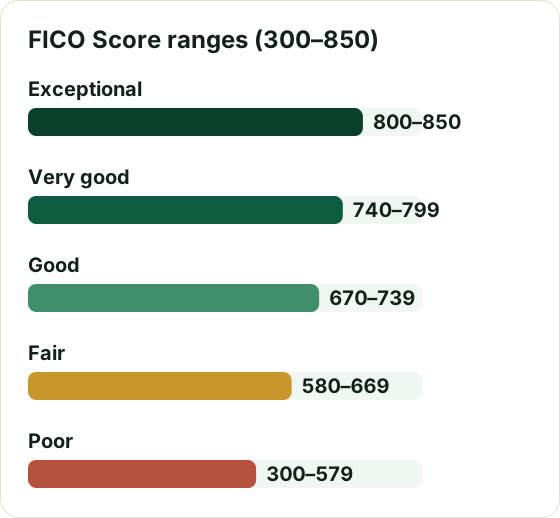
Quick answer: on the FICO scale, which runs from 300 to 850, a good credit score is 670 or higher. Scores of 740–799 are very good and 800–850 are exceptional. Below 670 is “fair” (580–669) or “poor” (300–579).
Your credit score is a number that sums up how reliable you are at paying debts. It decides whether you’re approved for a card, a loan or an apartment — and how much interest you’ll pay. Below you’ll find the full range chart and a score-by-score guide, so you can see exactly where your number lands.
The most widely used score in the U.S. is the FICO Score, which ranges from 300 to 850:
| Range | Score | What it means |
|---|---|---|
| Exceptional | 800–850 | Access to the best rates and offers |
| Very good | 740–799 | Very good rates; easy approval |
| Good | 670–739 | Approved for most products |
| Fair | 580–669 | Approved for some products, at higher rates |
| Poor | 300–579 | Hard to get traditional credit |
In short: 670 and above is considered a good score, and 740+ is very good. According to FICO’s most recent data (2026), the average FICO Score in the U.S. is around 714.
Find your number in the table:
| Your score | FICO range | Is it good? |
|---|---|---|
| 800–850 | Exceptional | Yes — the top tier. You’ll usually qualify for the best rates and offers. |
| 740–799 | Very good | Yes — very good rates and easy approvals. |
| 700–739 | Good | Yes — a solid score for most cards and loans. |
| 670–699 | Good | Yes, but you’re near the bottom of “good”: a few points down puts you in “fair”. |
| 620–669 | Fair | Not yet. You can get approved for some products, usually at higher rates. |
| 580–619 | Fair | Lower end of fair. Many lenders will decline or charge much more. |
| 300–579 | Poor | No. Focus on rebuilding (see the steps below). |
It’s another scoring system that also runs from 300 to 850, created by the three credit bureaus. Many free apps show your VantageScore, while most lenders use FICO. That’s why it’s normal to see slightly different numbers in different places. What matters is the trend: if it rises in one, it usually rises in the others.
| FICO range | FICO label | VantageScore 3.0 range | VantageScore label |
|---|---|---|---|
| 800–850 | Exceptional | 781–850 | Excellent |
| 740–799 | Very good | 661–780 | Good |
| 670–739 | Good | 601–660 | Fair |
| 580–669 | Fair | 300–600 | Poor |
| 300–579 | Poor |
The rows don’t line up one to one: the two models draw their ranges differently, and credit bureaus don’t always use the same labels. A lender may also set its own cutoffs.
| Factor | Share of your score | What it looks at |
|---|---|---|
| Payment history | About 35% | Whether you pay on time |
| Amounts owed | About 30% | How much you owe, including your credit utilization |
| Length of credit history | About 15% | How long your accounts have been open |
| New credit | About 10% | Recent applications and new accounts |
| Credit mix | About 10% | The types of credit you have, such as cards and loans |
So the two habits that matter most are paying on time and keeping your card balances low. Check yours with our free credit utilization calculator.
A lot. For example, on a $25,000 car loan over 60 months, paying 6% instead of 12% interest saves you more than $4,000 (we explain it in how car loan interest works). The same goes for cards, personal loans, mortgages and, in many states, even car insurance.
There’s no single number, because each lender sets its own rules. These are general guides:
| What you want | Score that usually helps | Good to know |
|---|---|---|
| Regular credit card | 670+ | With no history or fair credit, start with a secured card |
| Car loan | Varies a lot | Lower scores can get approved, but at much higher rates |
| Personal loan | 670+ for better rates | See personal loans with bad credit if you’re lower |
| Apartment | Set by each landlord | Many also look at income and rental history |
| Mortgage | Often around 620+ for conventional loans | FHA loans can go lower, and 740+ usually gets the best rates |
If you’ve just arrived or never had credit, you may have no score (which isn’t the same as a bad one). Start with how to build credit in the U.S. from scratch or, without an SSN, how to build credit with an ITIN.
Need to improve quickly? Read how to raise your credit score fast. Starting from zero? See how long it takes to build credit. Is card debt holding your score down? Compare the debt avalanche vs. snowball methods.
| Possible cause | What to do |
|---|---|
| Your card balance went up | Pay it down. This can recover quickly once a lower balance is reported |
| A payment was reported 30+ days late | Get current right away, and ask the lender whether it can help if it was a one-time mistake |
| You applied for new credit | A hard inquiry usually costs only a few points |
| You closed a card | You lost its limit, so your utilization may have gone up |
| There’s an error or fraud | Check your reports and dispute it |
Small changes of a few points are normal, because your score updates as new information is reported.
What is the credit score range? FICO Scores go from 300 to 850. VantageScore, the other common model, uses the same 300–850 scale, but its categories are drawn a little differently.
What is considered an excellent credit score? On the FICO scale, 800–850 is “exceptional” and 740–799 is “very good”. Most people mean one of those two ranges when they say “excellent”.
What score do I need for a credit card? For regular cards, a “good” score (670+) is usually enough. With fair credit or no history, start with a secured card.
What score do I need to buy a house? It depends on the loan type: some programs accept lower scores, but the best rates usually require 740 or higher.
Does my credit score from another country count? Usually not. Your history starts from zero in the U.S.
This article is for educational purposes only and is not financial advice. Ranges can vary slightly by model and lender. Read our Disclaimer.
Links open the official websites. Rules change: always check the latest information there.
How long it really takes to build credit from scratch: when you get your first score, what happens at 6, 12 and 24 months, and how to reach 700+ faster.
We ran the numbers on $10,000 of credit card debt. See how the avalanche and snowball methods compare on time, interest and motivation.
How to use a 0% balance transfer card to pay off debt interest-free: fees, promo periods, traps to avoid and a worked example with $5,000.