Quick answer: payday loans are fast but very expensive. In our example, $60 in fees every two weeks adds up to $300 in fees in about 10 weeks if you keep rolling the loan over. Before you take one, try a credit union payday alternative loan, a payment plan or a pay advance from your employer.
When money runs short before payday, a payday loan looks like a quick fix: no credit check and cash in minutes. But it’s one of the most expensive ways to borrow. Before you sign, look at the numbers.
What is a payday loan?
It’s a small loan (usually a few hundred dollars) that you must repay all at once on your next payday, typically in about two weeks. To make sure they get paid, lenders ask for a post-dated check or access to your bank account.
The real cost
A typical fee is $15 for every $100 borrowed for two weeks. That sounds small, but it works out to an APR of almost 400%, according to the CFPB. A credit card, by comparison, is usually 20% to 30%.
The trap: rollovers
Many people can’t repay the full loan plus the fee in two weeks, so they roll it over: they pay just the fee, and the loan continues.
Example with $400:
Fee every two weeks: $60.
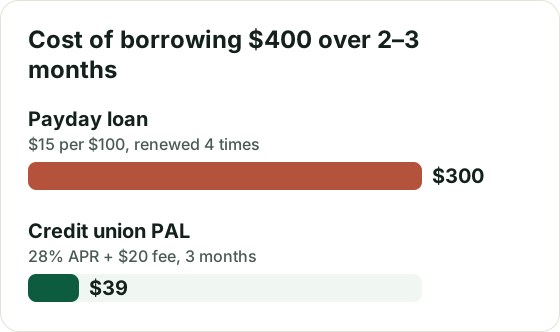
Roll it over 4 times and pay it off on the fifth, and in about 10 weeks you’ve paid $300 in fees — and you still have to repay the $400.
With a credit union Payday Alternative Loan (PAL) (up to 28% APR), borrowing $400 and repaying it over 3 months would cost about $39 in total, including the application fee.
7 cheaper alternatives
Payday Alternative Loans (PALs) from federal credit unions. Designed specifically to replace payday loans: small amounts, a maximum APR of 28% and a capped application fee (up to $20). Not every federal credit union offers them, and you usually need to have been a member for at least a month.
Negotiate with whoever you owe: many utilities, hospitals and landlords accept a payment plan if you ask before you fall behind.
A pay advance from your employer, or an earned wage access app offered through your job. Check the fees carefully.
A small personal loan from a bank or credit union, even with fair credit.
A credit card for a one-time purchase (not a cash advance, which is expensive), if you can pay it off soon.
Community assistance: local organizations, churches and public programs for food, rent or utilities. Dial 211 in the U.S. to find them.
Nonprofit credit counseling, if debts are piling up.
If you already have a payday loan
Avoid rolling it over if you can. Ask whether the lender offers an extended payment plan — some states require it.
Prioritize repaying it over non-essential spending.
If a lender threatens you or collects abusively, file a complaint with the CFPB and your state regulator.
FAQ
Do payday loans build credit?
Usually not — most don’t report payments to the bureaus. But if you don’t pay and the debt goes to collections, it can hurt your credit.
Are they legal in every state?
No. Some states ban them or tightly cap their cost.
How to find a credit-builder loan near you: credit unions, community banks, CDFIs and online lenders, what each costs, what to ask and how to tell if one is worth it.